Showing posts with label Discussion. Show all posts

Tuesday, January 27, 2015

Winnipeg Tagged The Most Racist City In Canada


Metro
Maclean’s magazine calls Winnipeg the country’s “most racist” city in its latest edition.

In an interview on 660news.com the magazine’s associate editor Nancy Macdonald said the magazine started looking at racism felt by Winnipeg’s aboriginal community after the body of 15-year-old Tina Fontaine was found in the Red River in the summer.

“It was an atrocious story and it hit home in Winnipeg in a way that I’ve never seen before with a murder of a young aboriginal person,” explained Macdonald.

McDonald said the article, which hits newsstands today, includes accounts of aboriginal people in Winnipeg who say they experience racism every day.

Monday, October 13, 2014

Supreme Court Barred Civil Claims by Canadians Tortured in a Foreign State?


In a disappointing decision released this morning, the Supreme Court of Canada has barred civil claims for torture committed by a foreign state, even where the victim is a Canadian citizen.

In July 2003, Zahra Kazemi, a Canadian citizen and journalist, died in Iran. She had been arrested for taking photographs of protestors in front of Evin prison in Tehran and, while in detention, was beaten, raped and tortured by Iranian government officials. She died as a result of injuries sustained.

In 2006, Ms. Kazemi's son, Stephan Hashemi, instituted proceedings in Canada against the Islamic Republic of Iran; the Ayatollah Ali Khamenei, Supreme Leader of Iran; Saeed Mortazavi, the Chief Public Prosecutor of Tehran; and Mohammad Bakhshi, former Deputy Chief of Intelligence of Evin Prison. The lawsuit sought damages on behalf of Ms. Kazemi's estate and the psychological harm to Mr. Hashemi.

The main question at the Supreme Court of Canada was whether Canada's State Immunity Act (SIA) was a complete bar to claims for damages related to the torture of a Canadian citizen abroad, and whether the provision was therefore contrary to section 7 of the Charter.

Why Can't We Make Marriage A Three Year Renewable Contract?


Special to The Globe and Mail

Divorce rates are soaring, the younger generation has abandoned committed relationships, and marriage is redundant in a world in which women are self-sufficient, or so the story goes at least. Desperate times call for desperate measures, and a willingness to entertain legal reforms to marriage that a generation ago we would have considered completely absurd.

One such proposition is to take the long-term commitment out of marriage and, instead, have marriages that automatically expire after a fixed term of three or four years. Couples who wished to remain married at the end of the contract would have the option of hiring a lawyer to renew their contract for another fixed term, while those who wished to split would be spared the expense, and stigma, of a divorce

Let’s ignore for a moment the fact that divorce rates in Canada today are no higher than they were 30 years ago, and that the overwhelming majority of young people plan to marry one day, and that women who are capable of being self-sufficient are actually more, not less, likely to be married. What would we lose by replacing the current “until death do us part” approach to marriage with a series of short-term contracts?

Tuesday, October 7, 2014

Would You Rock These Condom PANTS?

Made from rubber latex – the same material as normal condoms - Scroguard covers the whole area, shielding the skin and blocking genital secretions

A 'scrotal condom' has been developed to cover the entire crotch area during sex, to lower the risk of catching sexually transmitted infections (STIs).

Would you wear condom PANTS? New 'scrotal shield' which covers entire genital area is developed for safer sex

  • 'Scroguard' has been developed by two entrepreneurs in the U.S.
  • Made from latex, it covers entire crotch area, reducing skin on skin contact
  • Sexually transmitted infections (STIs) can be transmitted this way
  • Normal condoms covering the penis do not protect the whole pubic area 
  • However, product has not been officially approved to protect against STIs
  • Manufacturer warns the pants may make 'farting sound' if air gets in imside

Scroguard is worn with a condom and reduces skin on skin contact, lowering the risk of catching infections like herpes or genital warts which are transmitted through contact with skin.

It has been designed people who want extra 'peace of mind', men with a high sex drive who enjoy sexual variety and couples and individuals who 'love to swing', developers said.

STI's are transmitted through unprotected sex, genital secretions, skin-on-skin contact or contact with open sores.
Scroguard is worn with a condom and reduces skin on skin contact, lowering the risk of catching infections like herpes or genital warts which are transmitted through contact with skin

MPs to resume debate on Iraq mission Today


Opposition MPs continued to criticize the government’s plan to join airstrikes against Islamic State militants during debate in the House of Commons Monday, even as the Conservatives announced additional humanitarian aid for victims of ISIS.

MPs will resume debating a motion on committing Canadian Forces to an air campaign against ISIS on Tuesday, with a vote expected late in the day. Given the Conservative majority, there is no question the motion will pass.

Early on in the House of Commons debate Monday, Foreign Affairs Minister John Baird said he wants Canada to show a "strong and united front" in the fight against ISIS.

This is not just another conflict,” he said. “The struggle is not against a state or even a foreign dictator. This is a struggle against a group of terrorists that rape and pillage and slaughter anything and anyone that stands in their way.”

Baird also announced that Canada will contribute $5 million in aid to help victims of sexual violence perpetrated by ISIS militants, and another $5 million to investigate and prosecute the attackers. He noted, however, that providing aid is not enough and that the world can't confront ISIS "solely armed with bandages, platitudes and investigation."

Both the NDP and Liberals have said they oppose the mission, citing concerns that once involved in Iraq, it will be difficult for Canada to leave.

CTV News has confirmed a small advance team from the Canadian Forces is heading to an undisclosed country in the Middle East to prepare for the CF-18s that will take part in Canada’s combat mission.

Tuesday, September 16, 2014

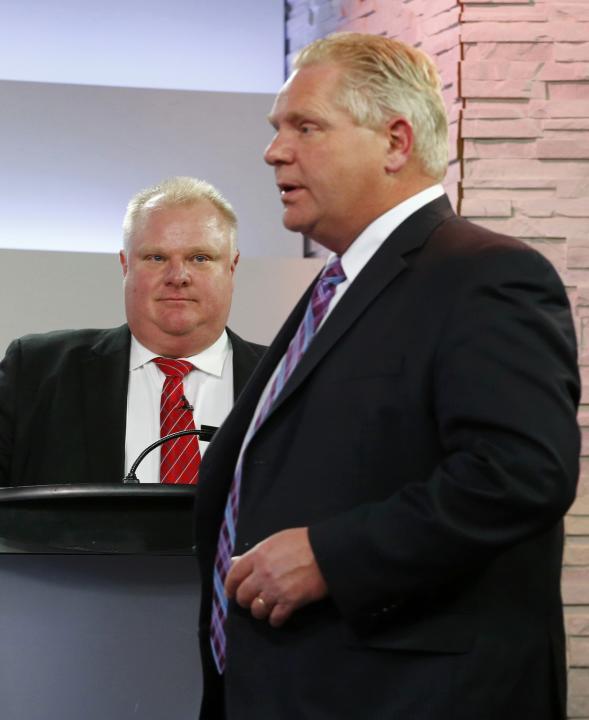
Doug Ford For Mayor: Could He Actually Win Toronto Mayoral Election?

Doug Ford is running for mayor of Toronto in Rob's stead.

But does he have the same chances that his brother did to win?

That's the question facing pollsters after a day of dramatic changes in Toronto's political landscape.
Rob, whose tumour diagnosis was revealed Wednesday, will now vie for a council seat in his old Etobicoke ward while his nephew Michael runs for school trustee in a neighbouring ward.

The most recent Forum Research poll from Sept. 8 showed that Rob trailed John Tory in the mayoral race by just 12 percentage points, with 28 per cent support against Tory's 40 per cent. Another poll conducted by Nanos Research between Aug. 27 and 31 showed Tory at 42 per cent support and Rob Ford at 28 per cent.

UPDATE: A poll conducted by Forum Research Friday night found newly entered mayoral candidate Doug Ford in second place with 34 per cent of voter support. John Tory led the poll with 41 per cent support, while Olivia Chow held third place at 19 per cent, according to the Toronto Star.
Forum president Lorne Bozinoff told Canada.com that he thinks Doug could still pose a threat.
"He's got the name recognition already, the campaign organization, everything," he told the website.
"If he can pick up where his brother left off ... he's got six weeks to close a 12-point gap, I think that's possible."

Monday, September 15, 2014

Can Happiness Be Bought?

First the cathedral and then the cafe? Experiences like travel bring greater satisfaction than material goods, researchers say.

You Can Buy Happiness, If It's An Experience. We humans spend a lot of time waiting in lines: People queue up for days in order to get their hands on the latest iPhone, or what feels like eons for a table at that hip new brunch place.

You may be better off spending time and money on the latter. A growing body of research has shown that experiences tend to make people happier than material possessions.

And even anticipating an experience like a concert, a ski trip or what better be a really great brunch makes us happier than purchasing the latest gadgets, according to a study published Tuesday in Psychological Science.

The study, cleverly titled Waiting for Merlot: Anticipatory Consumption of Experiential and Material Purchases, tracked how about 100 college students and over 2,200 randomly selected adults felt about material goods and experiences.

People got excited about both things and events. But they tended to feel more positive about experiential purchases, and their feelings about material purchases were more likely to be tinged with feelings of impatience.

Saturday, September 13, 2014

The '10,000-hour' rule revisited: Why practice may not make perfect

 Did Microsoft founder and philanthropist Bill Gates need 10,000 hours of practice to become the success he is today?
Did Microsoft founder and philanthropist Bill Gates need 10,000 hours of practice to become the success he is today? (Susan Walsh/Associated Press)

When Malcolm Gladwell published Outliers, his bestselling book proposing that practising a certain task for around 10,000 hours is necessary before one can ever achieve great success, he gave hope to millions of wannabe Bill Gateses, Carl Sagans, Tiger Woodses, Yo-Yo Mas and yes, even Malcolm Gladwells.

But he also dashed the dreams of millions of slackers hoping to justify their poor work habits, believing no matter how hard they tried, they could only get so far.

However, just in time for school, there may be a sliver of good news for the terminally lazy.

"Our data suggests that overall on average, practice is important but not nearly as important as, say, Malcolm Gladwell would claim — that it accounts for everything or almost everything,"
said Brooke Macnamara, an assistant professor at Case Western Reserve University in Cleveland.

It was Macnamara, along with fellow psychologists Frederick Oswald of Rice University and Zach Hambrick of Michigan State University, who decided to launch a comprehensive look at the claims popularized by Gladwell by examining 88 studies that looked into the relationship between practice and performance. The psychologists wanted to find what, if any, correlation there was between the two.

What they found and recently published in the journal  Psychological Science was that while practice does play a role in one's ability to say, play chess, or the violin, it's certainly not the defining element for success.

It also depends on what the task is. For games, like chess, practice played a larger role. For this task, the researchers found it accounts for about 26 per cent of one's overall ability. Music was 21 per cent, sports 18 per cent, education four per cent and professions less than one per cent.

All this means, according to the study, is that no matter how hard one practises a particular task, they can only become so good at it, or, in some cases, remain so mediocre.

Wednesday, August 13, 2014

Account of a Gay Mormon's Complicated Journey

What happens when your religion does not reflect who you are? (REUTERS/Jim Urquhart)      
Alasdair Ekpenyong had never heard of a gay Mormon before. It seemed like a paradox, an oxymoron. "What is a gay Mormon?" he asked.

"It's someone who stays in the Mormon community," Rick replied, "even while dating someone of the same gender."

Rick was recounting his life for Alasdair and a group of visitors. He was not a gay Mormon anymore — he'd left the faith years ago, fed up with feeling unwelcome in his own religion. So now Rick was just a gay man with a towering stature and a scraggly beard. On this day he was also wearing a dress, a detail that made Alasdair squirm in his slacks. In Alasdair's mind, men simply did not wear dresses. But then, Twin Oaks Intentional Community was not supposed to resemble Alasdair's mind.

Alasdair was Mormon, and Twin Oaks was the sort of place that could make a Mormon blush. Twin Oaks was a Virginia commune with a reputation for liberal politics and libertine sexuality, and Rick's room was a stop on the visitor tour.

It was April 2012. Alasdair was twenty years old and found himself in the commune as a researcher, studying the strange ways of people like Rick. It was a bit of a role reversal — Mormons are used to finding themselves under the microscope, studied as if they were an odd lichen on the boulder of America. There's always a species stranger than your own.

Alasdair had just finished seven months of missionary work in Salt Lake City, helping with church genealogy projects. Young Mormon men usually become missionaries in their late teens, often traveling overseas to spread the faith and immerse themselves in scripture, or working domestically like Alasdair. A two-year Mormon mission requires such discipline that it can seem like a kind of spiritual infantry, with all the surveillance and rigidity you'd expect of a foot soldier of faith.

Missionaries remain constantly in pairs, adhering strictly to schedules, dress codes, and prohibitions on any form of entertainment other than scripture.

Friday, August 8, 2014

Harper is all Talk and No Action Against Putin Says Senatoor Colin

Stephen Harper likes to poke the bear a.k.a. Vladimir Putin.

The Canadian prime minister has slammed Putin's "expansionism and militarism" and called the Russian president a "throwback" to the evil mindset of the Soviet Union.

In terms of the words Mr. Harper uses, I appreciate his forthright condemnation of Putin's behaviour in Ukraine. The 20th century was an ugly one for Europe, and the world can't afford leaders colouring outside the lines when it comes to annexing territory or messing with the internal affairs of its neighbours.

Historians J.L. Granatstein and William Kaplan have co-authored an article applauded the Canadian prime minister for being ahead of the pack in identifying Putin's nasty behaviour in Ukraine, outing him as "a Stalinist using Nazi big lie techniques and Soviet-era disinformation tactics to camouflage his government's actions and shift blame."

They commended Harper's exhortations to Canada's allies to mobilize to counter Russian expansionism -- to activate NATO and to impose economic sanctions to make Putin think twice about throwing his weight around. All good.

But these words are fluff unless Canada is willing to put its money where it's mouth is when it comes to standing up to the Putins of this world.

This government, which swaggers around in fatigues, pretending to be a friend of the Canadian Forces, has a lot to answer for when it comes to maintaining a military that can play its role in the world when these kinds of crises arise.

Thursday, August 7, 2014

WHO Calls For Emergency Meeting on Ebola in Swtizerland

Ebola virus in Africa outbreak is a new strain
Global health experts at the World Health Organisation are meeting to discuss new measures to tackle the Ebola outbreak.

The meeting – being held in Geneva, Switzerland – is expected to last two days and will decide whether to declare a global health emergency.

That could involve imposing travel restrictions on affected areas.

The outbreak began last February and has since spread to four African countries, claiming nearly 900 lives.

It comes as leading infectious disease experts have called for experimental treatments to be offered more widely.

Two US aid workers who contracted Ebola in Liberia appear to be improving after receiving an unapproved medicine before being evacuated back to the US.

Saturday, August 2, 2014

Why Is The Western World So Afraid Of Islam?

 
Don't expect much support. (AP Photo/B.K. Bangash)

  
Fear of Islamic radicalism cows the West into silence on Christian persecution.
 
In perhaps the only sign of action from the West to the increased intensity of Christian persecution, France has opened itself up to refugees from Iraq, who are being driven out under pain of death by ISIS. This is a welcome reversion to form for France, which ever since the Middle Ages has periodically found ways to protect Christian minorities abroad. This is a great beginning — but it is such a small response to the magnitude of Christian persecution, happening not just in Iraq and Syria, but in Nigeria and Egypt as well.

Why hasn't there been a greater response from the once-Christian West to the plight of Christians? It's not for lack of outrageous events. The International Society for Human Rights estimates that 80 percent of acts of religious discrimination in the world have Christians as their victims. And these are starting to poke through the headlines. The purge in Mosul attracted some attention, the kidnapping and threatened murder of mostly Christian girls by Boko Haram even more. But much less is said about the fate of Syrian Christians or Copts. Still less is said about even more obscure religious minorities like Yazidi and Druze who face discrimination from ISIS.
 
One reason for our silence, suggested by John Allen Jr. in his book The Global War on Christians, is that the modern humanitarian West has difficulty seeing Christians as "native" to third-world nations. Their imagination of "global" Christianity is one of a religion implanted by Europeans and Americans through a violent, racist, and discredited colonialism. Of course this isn't true in these cases, as there were Christians in Iraq, Syria, and Egypt long before there were any in Britannia or Biloxi. Allen also cited French philosopher Regis Debray's view that in Christian persecution the victims are "'too Christian' to excite the Left, and 'too foreign' to excite the Right."

Thursday, March 27, 2014

Canada, Russia continue to talk as part of Arctic Council meeting

Canada, Russia continue Arctic talks
Environment Minister Leona Aglukkaq answers a question during question period in the House of Commons in Ottawa, Thursday, January 30, 2014. (Sean Kilpatrick / THE CANADIAN PRESS)

Canada may be upset at Russia over Ukraine, but conversations with the bear continue over the Arctic.

Government officials confirm that a Russian delegation is attending a meeting in Yellowknife this week held by the Arctic Council, an eight-member group of countries that ring the North. All members are attending, even though the council includes some of Russia's harshest critics, such as Canada and the United States.

Friday, March 7, 2014

How Canada’s Image is Being Redefined by Rob Ford and Justin Bieber

As disruptive events help shape countries into what they stand for today, I believe Canada is going through its own brand revolution, or maybe evolution. With our recent success at the Sochi Olympics, Justin Bieber’s highly visible troubles with the law, and our very colourful Toronto mayor all making international headlines, I am noticing the perception of Canada is shifting from staid, conservative and somewhat low-key to one that better reflects the colour of our flag – namely energetic, flamboyant, and loud.

Historically, Canada has had a reputation for being restrained. Even our successful, high profile Canadian superstars who prospered in Europe and America helped maintain this perception of our country. During my many travels, any mention of Canada would bring references to Quebec, our winters and hockey.