Showing posts with label Personal Finance. Show all posts

Monday, March 21, 2016

THE RICH VS. THE POOR MENTALITY


Poor vs Rich
THE RICH VS. THE POOR MENTALITY: 44 STRIKING IDEOLOGIES OF THE POOR AND THE RICH

The poor says if I am rich
The rich says when I am rich

The poor says it has never been done before
The rich says it can be done

The poor always see a problem
The rich always see opportunities

The poor entertains fear
The rich exercise faith

Read full on ablethoughts

Friday, January 22, 2016

Inflation Close At 1.6% Due To Surge In Cost of Fruits and Vegetables

Trudeau
Prime minister-designate Justin Trudeau greets constituents at a subway station in his riding Tuesday, October 20, 2015 in Montreal, the morning after winning a majority government in the federal election. THE CANADIAN PRESS/Paul Chiasson

Canada's highest income earners face the prospect of higher taxes under a new Liberal majority government, but those in the middle can expect a break.

Keith MacIntyre, a tax specialist at accounting and consulting firm Grant Thornton, says people in the middle tax brackets could see a reduction in the federal income tax they'll be required to pay if Justin Trudeau's promises are put in place.

"Certainly people in those brackets will be looking forward to that in terms of additional cash flow," MacIntyre said from Halifax.

Tuesday, December 15, 2015

Down Payment For Mortgage Increases to 10% On Homes Over $500K


The federal government is increasing the minimum down payment required to buy a home for more than $500,000 in an effort to cool the red-hot housing markets in Toronto and Vancouver, but some economists say the impact on housing activity will be minimal.

Finance Minister Bill Morneau made the announcement in Ottawa on Friday. "We are looking at ways to ensure our market is stable and we want to make sure people are making the appropriate decision as they buy a new home," Morneau said during a news conference.

Starting in February, CMHC will require a 10 per cent down payment on the portion of any mortgage it insures over $500,000.

Tuesday, April 28, 2015

File Income Tax By May 5, CRA Extends Deadline Due To Human Error

CRA memo April 27

Janyce McGregor, CBC 
Canadians have been given five extra days to file their 2014 income tax returns, thanks to a "human error" at the Canada Revenue Agency.

Last Friday, the CRA issued a statement saying the deadline for filing tax returns electronically was May 5 at 3 a.m.

That was a mistake. On Monday, the agency issued a new statement, saying this year's deadline is, in fact, April 30.

Monday, January 19, 2015

Meet Vancouver couple who struggles to make ends meet despite making $25,000 a month

This destitute doctor has so little money he\'s turned his pockets inside out. How will he find cash for coffee on those rare days he heads to work?
PHOTO: FOTOLIA
Eric and Ilsa put lifestyle ahead of financial concerns but it has put them in a bit of a bind. He is 41 and a physician, she is 39 and a dentist.

They have five children, ranging in age from less than a year to 9, all of whom will go to private school. They have substantial earning power – although Ilsa is on mat leave at the moment – but Eric chooses to work for less money than he could.

They are living rent free in a relative’s house (they pay taxes, utilities and upkeep) and “regret not having bought a house years ago,” Eric writes in an e-mail. Houses in their Vancouver neighbourhood have doubled in price in the past two years. The house where they live is going up for sale soon, so they need to move quickly.

Last fall, they bought a building lot for $1.1-million and are planning to build a house large enough for their family and a live-in nanny. But with a combined income of $360,000 ($450,000 when Ilsa returns to work) and an $800,000 mortgage, can they afford the builder’s $1-million price tag? Who will lend them the money?

Thursday, January 15, 2015

World decline in oil price to impact Canada real estate in 2015

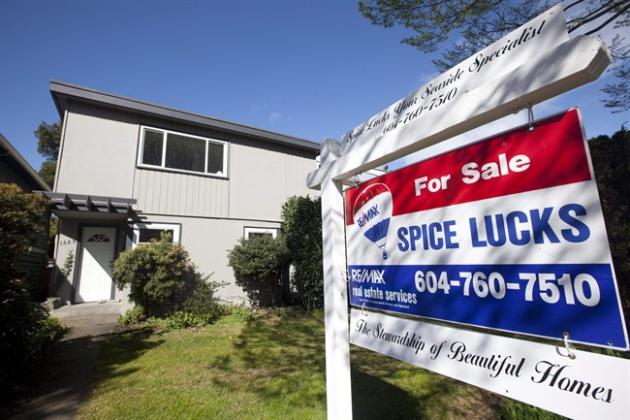
A for sale sign sits outside a home in Vancouver on April 8, 2010. Royal LePage says the price of a Canadian home is expected to rise by a relatively modest 2.9 per cent on average in 2015 as price appreciation slows across the country. THE CANADIAN PRESS/Jonathan Hayward
The Canadian Press - A for sale sign sits outside a home in Vancouver on April 8, 2010. Royal LePage says the price of a Canadian home is expected to rise by a relatively modest 2.9 per cent on average in 2015
By Alexandra Posadzki, The Canadian Press
Royal LePage says the price of a Canadian home is expected to rise by a relatively modest 2.9 per cent on average in 2015 as price appreciation slows across the country.
Toronto is expected to lead the pack when it comes to price increases this year, with the realtor saying the average home price in Canada's largest city is forecast to rise by 4.5 per cent, although that would be well behind last year's pace.
Vancouver is expected to see the second-biggest average jump in prices, up 2.8 per cent, followed by a 2.4 per cent gain in Calgary, 0.6 per cent in Montreal and 0.5 per cent in Halifax among several of the major centres surveyed across the country.

Friday, December 19, 2014

Canada Household debt hits record high

Credit cards are displayed in Montreal on December 12, 2012. A sustained period of low interest rates has allowed Canadians to rack up record levels of debt which, along with tumbling oil prices, pose a threat to the country's financial stability, economists say. THE CANADIAN PRESS/Ryan Remiorz
Alexandra Posadzki CPA sustained period of low interest rates has allowed Canadians to rack up record levels of debt which, along with tumbling oil prices, pose a threat to the country’s financial stability, economists say.

The total amount of credit market debt — which includes mortgages, non-mortgage loans and consumer credit — held by Canadian households hit a record high in the third quarter, climbing to 162.6 per cent of disposable income from a revised 161.5 per cent in the second quarter.

That means Canadians owed about $1.63 for every dollar of disposable income, according to the latest figures from Statistics Canada.

“The Bank of Canada has a lot on its plate in terms of assessing risk to the Canadian economy,” Leslie Preston, an economist at TD Economics, said in a note.

Thursday, December 4, 2014

New Reports Shows Average Canadian owes $20, 891 in consumer debt

A lineup of consumer credit cards. Elise Amendola/AP 
The Canadian Press
Canadians continue to pile on debt and now collectively owe more than $1.5 trillion, according to the latest figures from Equifax Canada.

The consumer credit rating agency says the level at the end of the third quarter was up 7.4 per cent from $1.409 trillion a year ago.

Nearly two-thirds of the total owed, or $985.1 billion, is mortgage debt.

Excluding mortgages, the average debt held by Canadians stands at $20,891.

The auto loan and installment loan sectors showed the most significant increases, at 6.8 and 5.8 per cent year-over-year respectively.

“Following a frenzied start to the festive shopping season with more to come in the countdown to Christmas, we can expect the consumer debt to rise even further,” said Regina Malina, senior director of decision insights at Equifax Canada.

Monday, November 3, 2014

Prime minister boosts monthly child benefit, unveils income splitting plan

Prime Minister Stephen Harper and his wife Laureen do arts and crafts with students at the Joseph and Wolf Lebovic Jewish Community Campus in Vaughan, Ont., on Wednesday, October 30, 2014. (Nathan Denette/THE CANADIAN PRESS)
Prime Minister Stephen Harper and his wife Laureen do arts and crafts with students at the Joseph and Wolf Lebovic Jewish Community Campus in Vaughan, Ont., on Wednesday, October 30, 2014.(Nathan Denette/THE CANADIAN PRESS)

BILL CURRY AND STEVEN CHASE | Globe and Mail
Prime Minister Stephen Harper has unveiled a package of family-focused tax cuts worth nearly $27-billion over six years that will shape the political debate heading into the 2015 election campaign.

The combined measures are worth about $4.6-billion a year and include income splitting for families with children under 18 and an expansion of the Universal Child Care Benefit, which delivers monthly cheques to families.

Income splitting will allow couples with children younger than 18 to transfer up to $50,000 in income from the higher earner to the lower earner for tax purposes, for a benefit that will be capped at $2,000. It starts with the 2014 tax year.

The Universal Child Care Benefit was a key pledge of the Conservatives’ 2006 platform, and delivers $100 cheques every month to families for each child under six. The government announced on Thursday that the monthly amount will rise to $160. Also, parents with children aged 6 to 17 would begin receiving monthly cheques worth $60 for each child in that category.

Friday, October 31, 2014

Prime Minister unveils family income splitting

Prime Minister Stephen Harper does arts and crafts with a student at the Joseph and Wolf Lebovic Jewish Community Campus in Vaughan, Ont., on Wednesday, October 30, 2014. Nathan Denette/The Canadian Press
Jennifer Ditchburn
The Canadian Press
Three months before millions of Canadians get their voter information cards for the 2015 federal election, they’ll find something else in their mailboxes: a cheque from the Conservative government.

A $60 monthly tax benefit for families with children aged six through 17 is the kind of targeted, easy-to-understand government initiative that helped the Conservatives claim victory in 2006. They’re hoping the same “keeping money in your pocket” message will keep them in power after the vote on Oct. 19, 2015.

Prime Minister Stephen Harper also announced Thursday the government will press ahead with income splitting for families with kids under 18 — a multibillion-dollar Conservative election promise from the 2011 election.

Those potential savings will kick in as soon as Canadians file their taxes in the spring.

Monday, October 20, 2014

The Ideology of 'Free' Health Care In Canada


 | HuffPost

"Don't touch my free health care," is a common refrain from defenders of the status quo whenever anyone broaches the topic of reforming Canada's health-care system.

While politicians and interest groups no doubt share a portion of the blame for perpetuating the myth of a $0 price tag for health care in Canada, their ability to carry public opinion with them stems from the murky manner in which health care is funded.

Individuals and families never see a bill for medical services, are not subject to any level of cost-sharing, and only pay a small so-called "premium" for health insurance (in provinces that impose them) that in no way represent the true cost.

The truth of the matter is that Canadians actually pay a substantial amount for health care through their taxes. But no one really knows how much.

And that is the key to the illusion.

Instead of using a dedicated health insurance tax that earmarks tax money for the specific purpose of funding health care, the government funds it through general tax revenue -- taking a few dollars from here and there so that it's impossible for families to add up the number for themselves.

Saturday, October 18, 2014

Goodnews For Canadian Homebuyers As Home Price Drops Pace


Good news for homebuyers: There are finally some signs that the astronomical climb in Canada’s average home price is starting to abate. The good news for home sellers? Prices are still growing at a steady pace, according to the most recent survey by one of the country’s biggest real estate firms.

The Royal LePage House Price Survey found the average price for a piece of real estate rose between 4.4 per cent and 6.1 per cent year-over-year in the third quarter of 2014.

Prices for detached bungalows rose the most — up 6.1 per cent to $405,101, while standard two-storey homes rose 5.5 per cent to $441,714. Condominium prices grew at the slowest pace, up 4.4 per cent to $257,377.

Condo prices in Toronto and Calgary bucked the slowing trend in the third quarter, with Toronto prices growing as much as eight per cent, while Calgary condos rose 11.9 per cent, according to the Royal LePage report.

Read in full on  HuffPost

Monday, October 13, 2014

Watchdog | Canadians overpaying EI to pad federal surplus

Sean Kilpatrick/The Canadian Press. Finance Minister Joe Oliver answers a question in the House of Commons, Tuesday, Sept. 16, 2014 in Ottawa.
The federal government’s handling of Employment Insurance will reduce job creation by 9,000 jobs over the next two years and compel Canadians to pay $4.5 billion more in EI premiums than needed, the Parliamentary Budget Officer says.

In an analysis of Finance Minister Joe Oliver’s recent decision to freeze EI premiums at a rate higher than needed for the EI account to break even, the PBO says the move will contribute significant extra revenues to Ottawa’s plan to run budget surpluses in the next few years.

After years of budget deficits, Oliver will be in a position to record budget surpluses starting next year.

Instead of using extra EI revenues to balance the federal government’s books, Ottawa could use the funds to make EI payments available to a higher proportion of jobless Canadians, the PBO says. Because of the increase in part-time jobs that don’t qualify for EI and an increase the number of long-term unemployed, only 38 per cent of unemployed workers are receiving EI payments, the report notes.

Tips | How To Start Planning Retirement


Like death and taxes, retirement is a reality. You can plan for it and make it what you want it to be, or you can stick your head in the sand and hope for the best. If you choose the latter, you should not be surprised if you get to your golden handshake to find your life far less satisfying than you’d hoped it would be. And since retirement will likely last 20 years or more, you’ll have lots of time to worry.  Want to avoid that? Take these steps:

Sign up for your company pension plan at work

If your manager told you tomorrow that there was a way to get a raise immediately, no questions asked, would you be interested? That’s what a company pension plan that matches your savings is all about. People who haven’t signed up are often unwilling to give up the money they want to spend on other things to save for a goal that may seem a very long way away. Unwilling to give up the $125-a-month specialty channel package because “TV helps you to relax?” Think about what it’s going to be like later when it’s time to hang up your hammer. Will you be saying, “Y’know, I’m really glad I had all those TV channels; it really makes this ramen noodle diet worth it?” Probably not.

Think about how you want to live in retirement

Do you dream of buying a sailboat and sailing through the Caribbean all winter? Do you want to spend time visiting your kids and grandkids? Are you planning to buy a cottage, renovate your home or travel? How are you going to pay for it?

Friday, September 12, 2014

New Reports Shows Poor Get Poorer and Rich Holding It in Canada

wealth concentration canada

Those rosy reports about Canadians’ net worth growing and the country's middle class being among the richest in the worldare masking growing inequality in the country, according to a new report.
The left-leaning Broadbent Institute says Canada’s poorest 10 per cent of the population saw their net worth drop some 150 per cent since 2005, while the top 10 per cent saw their net worth jump nearly 42 per cent in that time.
"This unequal distribution [of wealth] challenges the narrative that suggests Canadians are getting wealthier across the board," the report concludes.
The bottom 10 per cent have an average net worth of minus-$5,100, meaning on average the lowest earners have $5,100 more debt than assets, down from minus-$2,000 in 2005. The top 10 per cent’s net worth worked out to $620,600, on average.
StatsCan typically breaks out wealth numbers into “quintiles,” population groups of 20 per cent each. But the Broadbent Institute report’s broke those numbers down into “deciles,” or groups of 10 per cent, and that revealed greater extremes at the top and bottom ends of the income ladder.
The report found Canada’s top 10 per cent hold 47.9 per cent of the country’s wealth, but that’s actually down slightly from 2005, when they held 50.9 per cent. The share of wealth for the bottom four deciles shrank slightly, while the share of middle-income deciles grew slightly.
British Columbia had the greatest concentration of wealth in the top 10 per cent, with the top 10 per cent holding 56.2 per cent of all wealth in the province, while Atlantic Canada had the lowest concentration. Its top 10 per cent held 31.7 per cent of all wealth.

Financial Stress Involved If You Are One of the Striking B.C. Teachers

Kids and parents opposed to the teachers’ strike write in chalk on the False Creek seawall near Charleson Park in Vancouver. (DARRYL DYCK/THE GLOBE AND MAIL)
Jim Iker, president of the B.C. Teachers’ Federation, offers up praise for his union’s 40,000 members who have been on the picket lines since mid-June without strike pay.
“You have given up so much for your students and the future of B.C.’s education system,” he said Friday in an address to his members. “All British Columbians owe you their gratitude.”
The teachers have been offered similar words of solidarity and encouragement from others in the labour movement, but a pat on the back doesn’t pay the rent, and it is likely that teachers have already lost more money than they can hope to recoup by holding out. Mr. Iker’s words reflect that reality.
As he delivered his speech, the average B.C. public school teacher had already lost at least $6,000 in pay in this dispute.
For Surrey school teacher Jim McMurtry, the financial cost is wearing, but he’s also upset by the price that students are paying in lost class time.
“I feel like a soldier in the trenches of the First World War, congratulated for making a sacrifice I was duped into making,” he said.
It is never easy for a union member to offer a dissenting voice in the midst of a strike and he chose his words carefully: “This war over control of the B.C. education system has left me $14,000 poorer, owing in part to the cancellation of my summer-school job, and closed schools for half a million children for three months. Like all wars, it has stopped being about who is right but who is left – left with any public credibility.”

Now Its Getting Impossible To Save In Canada

The Canadian Payroll Association says things are getting tougher for working Canadians.The Canadian Payroll Association says things are getting tougher for working Canadians.

The CPA, in its sixth annual survey of thousands of Canadian employees, says it found more are living paycheque to paycheque, most are saving less than they should and even more are falling further behind in meeting their retirement goals.

The association said the survey found that more than half of employees — 51 per cent — would find it difficult to meet their financial obligations if their paycheque were delayed by a single week. That was up from an average of 49 per cent over the past three years.

For those aged 18 to 29, the number is even higher — 63 per cent report living paycheque to paycheque.

Wednesday, September 10, 2014

University Education in Canada To Cost 13% More

A protester tries to make a point concerning tuition fees as Montreal police stand guard outside the site of the International Economic Forum of the Americas on Monday, June 11, 2012. Peter McCabe/Canadian Press
Students will need deeper pockets to study at Canadian universities over the next four years with annual fees projected to rise 13 per cent on average to $7,755, having almost tripled over the past 20 years, according to a new report released Wednesday.

Students in Ontario can expect to shell out $9,483 on average in tuition and other compulsory fees in 2017-18. Fees in the province have nearly quadrupled over the last two decades, said the Canadian Centre for Policy Alternatives.

The high cost of getting a degree is an "enormous financial stress" for students and their families, said Erika Shaker, director of the left-leaning think-tank's education project.

"All the evidence both in Canada and the U.S. does indicate that financial stressers on students are even more pronounced than stressing about academic performance," she said.

But if high-school graduates don't like the idea of subsisting on a diet of Kraft Dinner and ramen noodles, they may want to head to Newfoundland and Labrador, which is getting top marks for its low fees that are projected to reach $2,888 in 2017-18. They've increased by 35 per cent over two decades.

Provincial funding for universities is inadequate, the report said. Universities are seeing it decline as a share of their operating revenue, while tuition fees are going up.

Several provinces are trying to "mitigate the optics" of ever-higher tuition fees with such policies as capping increases to the cost of living, it said.

Ontario offers to refund up to $1,780 in tuition fees to students. But it doesn't directly reduce tuition and doesn't apply to all undergrads, such as part-time students, the report noted.

Funding gap puts more costs on students